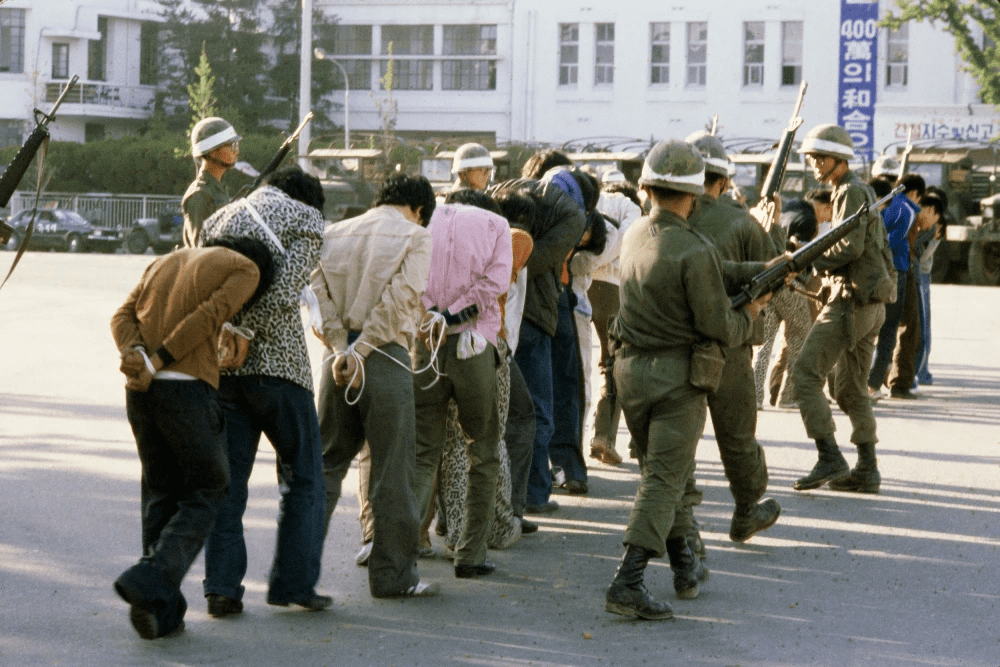
When the militant government tried to erase a massacre, the people made remembering an act of resistance.
The Gwangju Uprising—known in Korean as 5.18, after its date of origin on May 18, 1980—stands as one of the most traumatic and defining historical events in South Korea’s modern history. When the military dictator Park Chung-Hee was assassinated, General Chun Doo-Hwan seized power in a coup and extended martial law across the entire country, dissolving the National Assembly and banning all political activity.
It was in Gwangju, the capital of South Jeolla Province and a city long associated with political resistance, that the backlash erupted most fiercely. When paratroopers arrived to enforce martial law, students and citizens protested on the streets to demand democratic elections and freedom of assembly. The government’s response was disproportionate and brutal: soldiers beat, stabbed, and shot unarmed protestors, with atrocities occurring in schools, shops, and public squares.
The uprising’s aftermath extended well beyond the ten days of conflict itself. For nearly a decade, the South Korean government tightly controlled and actively suppressed historical records. Newspapers and television stations operated under strict censorship, while survivors and bereaved families risked surveillance, imprisonment, and intimidation if they spoke publicly. Official narratives portrayed the uprising as a riot instigated by dangerous agitators rather than a democratic movement crushed by state violence. It was only after German journalist Jürgen Hinzpeter secretly documented the massacre and smuggled his footage out of South Korea that the world began to understand the scale of the atrocities committed in Gwangju.
The most enduring weapon of authoritarianism is the erasure of memory. After the Gwangju Uprising, the military government tried to bury the truth alongside the dead, casting survivors as agitators and forcing the massacre into silence. But South Koreans refused to forget. Through memorials, literature, films, education, and annual commemorations, they have preserved the stories of those who died and ensured that Gwangju remains part of the nation’s collective conscience.
That legacy became especially visible on December 3, 2024, when President Yoon Suk-yeol declared martial law. South Koreans immediately recognized it as an attack on democratic institutions. Within hours, thousands of citizens gathered outside the National Assembly, while lawmakers forced their way inside to overturn the declaration. For many Koreans, the response was not simply a reaction to one political crisis. It reflected a collective memory passed down across generations—a shared understanding of what can happen when authoritarianism goes unchallenged.
Gwangju shows us that the memory of those who resisted endured long enough to defend it again. In South Korea, remembrance has become democracy’s greatest form of resistance, proving that when a nation refuses to forget, it becomes far more difficult to silence.
Further Reading & Media:
- Human Acts by Han Kang
- The Dog Thief by Lim Chul-Woo
- A Taxi Driver (2017)
- 12.12: The Day (2023)
- The Gwangju Uprising and American Hypocrisy
- Journalism and Censorship During the Gwangju Pro-Democracy Movement
- How Activists Kept the Memory of the Gwangju Uprising Alive
About the author:
Caroline Shin, based in Southern California, is the founder of the Liberation Archive. Often fueled by obscene amounts of caffeine, she spends her time taking hip-hop dance classes, working on her poetry, and scouting for the best matcha. Her favorite time of day is when the streetlights just begin to turn on.

