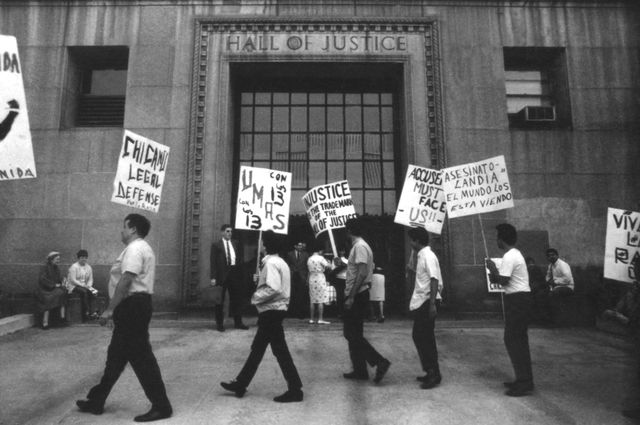
In early March 1968, at the height of the civil rights and anti-war movements, more than 22,000 Mexican American students walked out of their classrooms across East Los Angeles, all uniting to demand that their schools recognize their right to an equal education.
75% of the population in East Los Angeles school districts were Chicanos, or Mexican Americans. So when the schools failed to provide equal treatment in academics, they responded boldly.
The schools suffered from inadequate funding, crumbling buildings, and an unbalanced student to faculty ratio, with large class sizes averaging around 40 students. Students also faced discrimination against their cultural identities, facing punishment for simply speaking Spanish in the classroom. Their schools were failing to serve them and, in many cases, actively discouraging their advancement
The discriminatory actions developed a larger, generational issue. Chicano students were disproportionately steered away from higher education and toward low-paying, physical labor jobs. Due to hostile environments and institutional discouragement, Mexican American high school dropout rates were sky-high.
In response, students organized what became known as the East L.A. Blowouts. Over the first week of March, thousands left their classrooms and took their demands into the streets. Their actions drew national attention to educational discrimination and became a defining moment in the Chicano civil rights movement. The students were met with police violence and arrests, and several organizers were subsequently charged with conspiracy. Although their demands were not immediately fulfilled, their protests made it increasingly difficult for institutions to ignore the inequalities they had long tolerated.
The effects of this organizing extended beyond the streets. The following year, Mexican American enrollment at UCLA reportedly increased by 1,800%. Over time, Los Angeles schools also saw increased representation among Latino educators and administrators, alongside efforts to expand bilingual education and culturally relevant curricula. The Blowouts did not single-handedly produce every subsequent reform, but they helped build the momentum for a broader struggle over educational access and representation.
Today, the same societal structures cycle back.
Just a few months ago, schools across the United States participated in anti-ICE walk-outs. The whole nation witnessed waves of people, especially students, pause whatever they are doing and protest on the streets of their city, neighborhood, or school in order to demand change and stand in solidarity with all those affected by the unlawful deportations.
Still, people often dismiss student walkouts as performative: an excuse to miss class, a symbolic gesture that accomplishes nothing. This criticism suppresses the possibility of change by assuming that activism should be judged solely by whether it produces an immediate, measurable result. It overlooks the role collective action can play in making overlooked grievances visible, building solidarity, and sustaining pressure for change. If we deem any effort, no matter how small or ‘performative,’ as ineffective, we can’t open any gateways for progress.
The Chicano Blowouts do not guarantee that today’s protests will achieve the same results. They remind us, however, that young people still possess a gravitational willpower that can bring ignored injustices into public view and challenge institutions to change.
When students walk out today, the focus should home in on what conditions have made them feel that leaving the classroom is necessary, and whether the institutions they are challenging are willing to listen.
Visibility is not the same as victory, but it can be part of the path toward it.
Further Reading & Media:
- The Dawning of Diversity: How Chicanos Helped Change Stanford University by Frank O. Sotomayor
- Zoot Suit and Other Plays by Luis Valdez
- Yo Soy Joaquin by Rodolfo Gonzales
- Chicano! The History of the Mexican American Civil Rights Movement by F. Arturo Rosales
- https://www.ebsco.com/research-starters/history/east-los-angeles-walkouts/
- https://ca.pbslearningmedia.org/resource/ee799b78-4dd9-409d-9c84-361802731591/la-walkouts/
About the author:
Caroline Shin is based in Southern California and the founder of the Liberation Archive. Often fueled by obscene amounts of caffeine, she spends her time taking hip-hop dance classes, working on her poetry, and scouting for the best matcha. Her favorite time of day is when the streetlights just begin to turn on.

