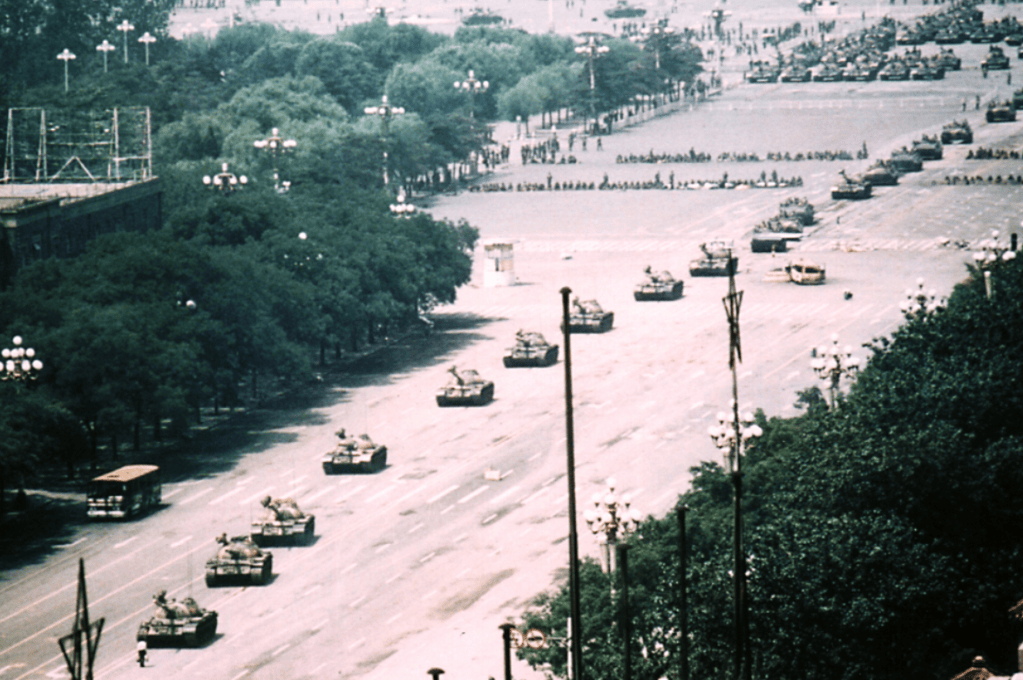
On June 5th, 1989, an unnamed man steps in the path of a column of Type 59 tanks. Armed with two grocery bags, he places himself squarely in front of forty tons of war machinery. The tank attempts to swerve; so does he. Waving an arm laden with what looks to be the morning’s shopping, he calls out to the vehicle. ‘Why are you here? My city is in chaos because of you.’
The night before, under their paper-mache Goddess of Democracy, student protestors were mowed down en masse. Linking arms in an attempt to stop the tanks from moving forward, the protestors had been run over. Soldiers fired indiscriminately into the crowd, bullets striking innocent bystanders in apartments and houses nearby. Bulldozers were dispatched to collect remains and incinerate them. Students who only hours before had rallied for peace and hope were hosed down the storm drains.
By 8 A.M., the massacre was over. The streets were filled with smoke and burned-out vehicles, the protestors well and truly dispersed. Almost three hundred citizens had lost their names and faces, crushed under the weight of the strongest regime in the world, with many more fleeing political persecution or injured.
It is perhaps symbolic that as the dawn rose, a lone figure took in the ruined streets of his city and decided–without hesitation or fanfare–to make a stand. This was a man who had just finished his daily errands, perhaps picked up medicine for a friend or had breakfast at his favorite spot; a man who wore ordinary slacks and a white shirt, who no doubt felt the same sense of helplessness and fear upon seeing his city under fire as every other soul in his vicinity did. A man who, against the odds, caused miles upon miles of army to come to a grinding halt.
To this day, his fate remains unknown. Some say he was pulled aside by concerned bystanders; others believe he was taken by plainclothes policemen. Whatever the case, he likely didn’t meet an enviable end as a symbol of resistance during one of China’s most brutal crackdowns. Perhaps the government thought that by leaving him nameless they could erase the grandeur of his actions.
Yet almost forty years later, the image of Tank Man remains a cultural fixture. His anonymity became his greatest strength instead. Although Tank Man is facing away from the camera, dwarfed by the might of the tank, every eye is inevitably drawn and seen in him – a human in a sea of machinery.
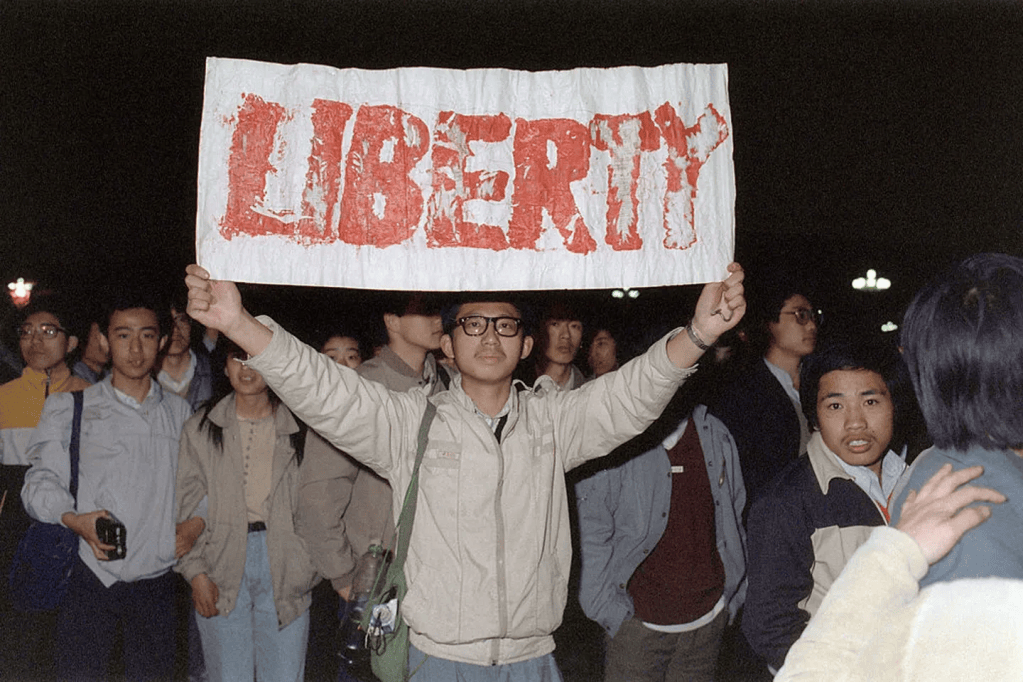
A question forms and is answered in the same breath: who? A Wang, a Li, a Chen; a student, a protestor, a bystander; a migrant, a Beijinger; Tank Man is everyone who has ever fought against the impossible. He’s the students who hunger-striked in Tiananmen Square for months in search of a better future. He’s the journalists who risked their lives to smuggle photos of him outside the country. He’s the soldier who stopped the tank and refused to crush his compatriot. He’s the Vietnamese monks who immolated themselves in protest of the Vietnam War, and the United States politicians who stood with them in the flames. He’s Gandhi’s marchers raising salt from the sea. He’s the Mothers of Plaza de Mayo, the White Rose, the Mau Mau. He is every unnamed hero whose sacrifice has paved the way towards the future.
It is easy to call Tank Man a hero, to laud his courage and strength as inhuman and noble. Yet, his actions prove the exact opposite. How many times have we felt that we are too small and helpless as a lone individual to do anything against “the system?” How many times have we been a cog in a machine, powerless to stop it? And how many times could we have acted?
It is fitting that to this day, Tank Man’s small figure–almost imperceptible–endures. The blurry photo of a solitary man standing up to tyranny strikes an indelible chord in every human heart. One lone individual to suspend the notion that change is impossible, one lone individual to continue the cycle of resistance and protest that exists in every generation.
“Almost certainly he was seen in his moment of self-transcendence by more people than ever laid eyes on Winston Churchill, Albert Einstein and James Joyce combined. The meaning of his moment–it was no more than that–was instantly decipherable in any tongue, to any age: even the billions who cannot read and those who have never heard of Mao Zedong could follow what the ‘tank man’ did.”
Pico Iyer, Time Magazine, June 1, 2018
Tank Man’s power lies not in the scale of his action, but rather in the spirit of his resistance. He is remarkable in his unremarkableness. He is extraordinary in his ordinariness. Anyone can be Tank Man—even you or I.
Additional Reading:
- Tiananmen Square Protests: 1989, Massacre & Tank Man | HISTORY
- Tiananmen Square incident | Massacre, Summary, Details, & Tank Man | Britannica
- The Unknown Fate of Tiananmen’s ‘Tank Man’ | RealClearHistory
- https://brucemaiman.substack.com/p/the-tiananmen-tank-man-lesson
- A Lesson From the Tiananmen Tank Men | Opinion
- http://www.chenrezigproject.org/our-teachers/tank-man-of-tiananmen-square/
- The Unknown Fate of Tiananmen’s ‘Tank Man’ | RealClearHistory
About the Author:
Rachel Li is a rising college freshman from Georgia. An alumni of Kenyon Young Writers Workshop and Iowa Young Writers studio, she writes love letters to life and all of its coincidences. In her free time, she enjoys art, reading, and making bad song covers. She looks forward to sharing more of her work with the world.

