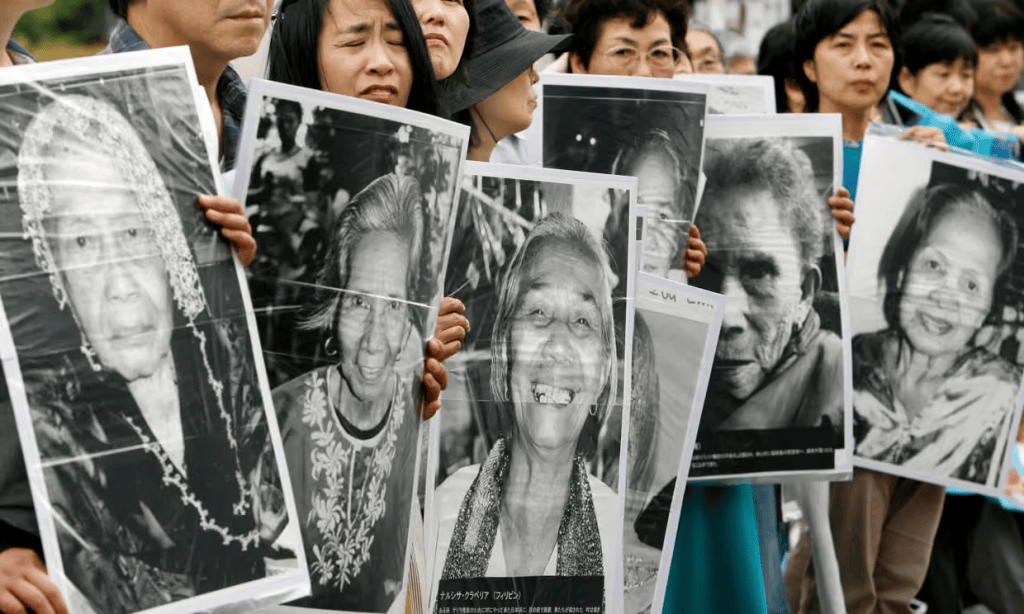
How survivor testimony has been institutionally dismissed in diplomatic agreements.
It has been decades, and the victims are still waiting for justice.
During Japan’s occupation of Korea, thousands of girls and women—including teenagers and children—were forcibly subjected to sexual slavery by the Imperial Japanese military. The violence was deeply scarring for a nation whose history of occupation continued to resound long after liberation.
An estimated 90% of the victims did not survive the war. Those who did have spent decades preserving their experiences through testimony, interviews, and recorded memories—living archives of endurance and resilience that remain accessible today. Their stories are more than remnants of a painful past; they carry the memory of a system of violence and the unresolved political questions surrounding responsibility, recognition, and justice.
In 2015, Japan and South Korea signed the Japan-South Korea Comfort Women Agreement. Japan expressed Prime Minister Shinzo Abe’s “sincere apologies and remorse” and provided 1 billion yen to a South Korean government-established foundation intended to support surviving victims.
However, the agreement failed to fully compensate or represent the victims it claimed to serve. The money was not structured as direct reparations from Japan to each survivor and instead distributed through a foundation established by the South Korean government. More fundamentally, survivors and human-rights advocates criticized the agreement for being negotiated without adequate consultation with the victims themselves.
The agreement also declared the issue “resolved finally and irreversibly,” effectively limiting future discussion or criticism between the two governments. This language was especially contentious because not all survivors accepted the settlement: of the 47 surviving Korean victims at the time, 35 received financial support through the foundation. In 2018, South Korea’s own review concluded that the agreement failed to properly reflect the victims’ wishes and therefore did not constitute a true resolution.
While the agreement represented a diplomatic attempt to address the issue, its shortcomings reveal what happens when political agreements speak over survivors; their memories risk becoming footnotes to diplomacy rather than testimonies of lived experience.
Further reading & media:
- https://international.ucla.edu/cks/care/comfortwomen_speakup/267562
- https://awf.or.jp/e6/index.html
- https://keia.org/analysis/the-comfort-women-agreement-5-years-on/
About the Author:
Caroline Shin is based in Southern California and the founder of the Liberation Archive. Often fueled by obscene amounts of caffeine, she spends her time taking hip-hop dance classes, working on her poetry, and scouting for the best matcha. Her favorite time of day is when the streetlights just begin to turn on.

