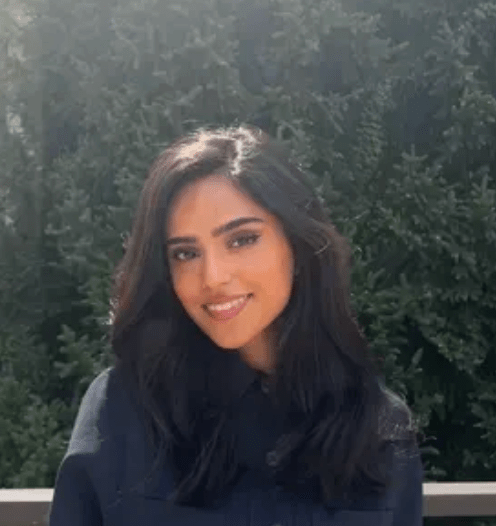
Manahil Naveed is a Pakistani journalist with a passion for uncovering underreported stories through investigative reporting and podcast production.
Naveed has worked with Al Jazeera English‘s award-winning podcast, The Take, lead producing an episode on racial bias in kidney transplant tests across the U.S. She has also worked with Transitions Media, where she reported on the social exclusion of Prague’s Romani community.
Having a background in strategic communication, Naveed brings a sharp analytical approach to storytelling, blending research with human-centered narratives.
When she’s not chasing stories, you can find her feeding treats to her pet cat, Venus.
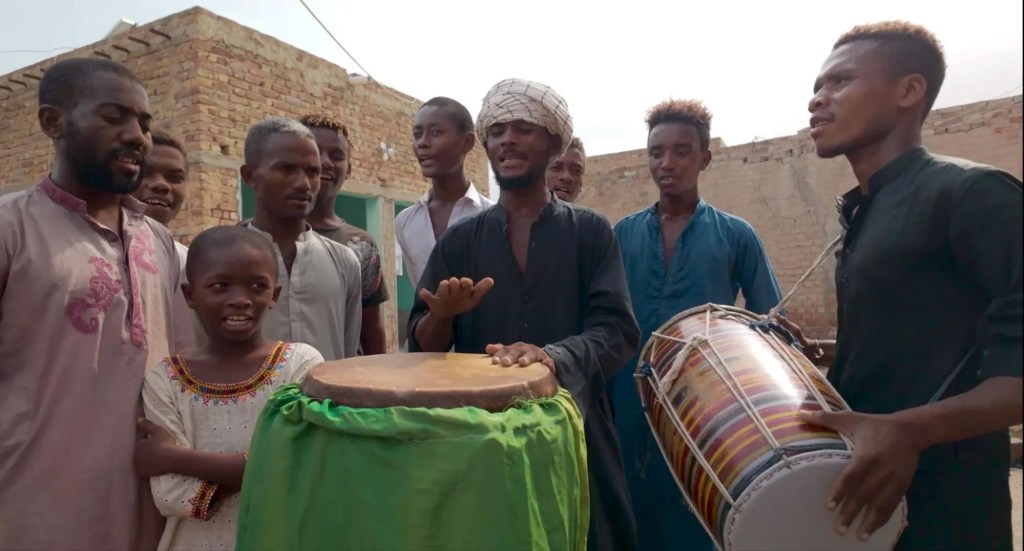
Her work on the Afro-descended Sheedi highlights the Pakistani sub-group’s Sheedi Mela—a yearly festival that celebrates the community’s resilience through rhythm and ritual.
This interview highlights Manahil’s reporting process and why histories like these matter.
Check out her work on the Pulitzer Center: https://pulitzercenter.org/people/manahil-naveed and her documentary: https://collab.sundance.org/share/Hum-Ahangi-2026-02-12-035050
Q The Liberation Archive: What first drew you to the Sheedi community as a subject? Was there a specific moment, an encounter, or something you noticed in how their story was being told?
A Manahil: That’s a great question. The way I came across the Sheedi community was pretty unconventional. A lot of Pakistanis, including myself, didn’t—and still don’t—know that this community even exists within Pakistan. I’m Pakistani, and I had no idea these people existed, or that they had such a rich cultural and historical background.
I first encountered the word “Sheedi” in an Instagram reel from a Pakistani content creator. I got curious and did a Google search. Everything I found, like the news articles and the coverage, was about their struggles: flooding, gang violence in Sheedi-populated areas, health issues. It was all issue-based reporting.
But the reel I saw was completely different. It talked about their culture, their traditions, their history. I realized those aspects weren’t being covered in mainstream media the way their struggles were. That gap felt like an opportunity for me to step in.
I’m fortunate that at Northwestern, I had access to resources and support. As my interest grew, I started applying for grants. The Pulitzer Center grant eventually came through and funded the project.
If I had to summarize why I chose to report on the Sheedi community, I’d say it was because of how deeply misrepresented they were. They were only seen through their issues, problems, and conflicts, and almost never through the lens of their solidarity, culture, and strength. That’s what pushed me to report on them.
Q The Liberation Archive: On that note, could you talk about the historical roots of the Sheedi community? How did they become a group pushed to the sidelines or forgotten in the Pakistani context?
A Manahil: When it comes to their history, there isn’t a lot of formal literature. There aren’t many written accounts of their migration, their journeys, or their past. So the community itself, and people like me who are trying to document them, rely heavily on oral history.
That means stories passed down from generation to generation. My evidence was largely primary sources: oral history interviews, conversations with elders, things that aren’t written down but are held in people’s memories. Through those, I was able to piece together a rough timeline.
The Sheedi community is present across the subcontinent—in both India and Pakistan. In my case, I focused on the Pakistani side. The people I interviewed identify as being of East African descent, particularly from places like Tanzania. They usually don’t have documents or legal records to show this. What they have are the stories told by their grandparents and older generations.
Historically, they came to the subcontinent through various routes. Some arrived through the slave trade, others through migration, and some for business. In my documentary, I primarily focused on how the slave trade routes brought them here and what the implications of that history have been over many centuries.
So, in short, they came to the subcontinent long ago, often through slave trade, and over time, because of limited documentation, structural neglect, and the way history has been recorded, they became marginalized and forgotten in mainstream Pakistani narratives.
Q The Liberation Archive: As a Pakistani journalist yourself, you mentioned that you had never heard of the Sheedi community before. How did you navigate your own identity in relation to theirs? And how did the community receive you when you first approached them?
A Manahil: That was actually a big internal struggle for me throughout this project. On the surface, yes, I’m Pakistani and they’re Pakistani. But between those two labels there are so many layers—of class, privilege, access, and power.
I come from an American institution, and not just any institution, but Northwestern. That comes with a certain backing and privilege. The way I speak, the way I present myself, the platforms I have access to—those are all forms of privilege that I carry into the room. So even though we share a nationality, we don’t walk into that space on equal footing.
I felt it was really important not to impose my own idea of what being Pakistani means onto them. I didn’t want to walk in with a singular, mainstream definition and force it on their experiences. Of course, that’s complicated, because you have to research a community before you can report on them, and research is always filtered through other people’s perspectives too.
In terms of how they received me: it was definitely not immediate trust. A lot of the pre-production work happened while I was outside Pakistan. I was doing reporting in Europe at one point, and I was reaching out to people in the Sheedi community through Instagram, TikTok, and other social media platforms.
Many of them said no. They told me things like, “We don’t know you,” or “We don’t want our community to feel intimidated by someone walking in with cameras and equipment.” They had been invaded before by YouTubers and vloggers who showed up, filmed a few clips, and left, portraying them in distorted and harmful ways. They had one too many experiences of journalists coming in, asking five questions, leaving, and then producing coverage that didn’t reflect who they truly are.
Because of that history, they had some reservations about me. Building trust took about a year. Before I ever showed up with a camera, I spent that time reaching out, texting, calling, explaining myself, but also just asking how they were doing.
And once I was finally on the ground, I tried not to pull out my camera at every moment. I focused on having open, vulnerable conversations off camera over tea, over food, just as one human being to another. Those off-camera moments were what made the on-camera moments possible later.
It was a slow process of building trust. I had to be patient, and I had to accept that in their eyes I was initially an outsider and an intruder. Over time, that started to change.
Q The Liberation Archive: What was it like to be physically present at the Sheedi Mela? I imagine it must have been a very new and powerful experience.
A Manahil: It really was. There was a huge gap between reading about the Sheedi Mela and actually being there. Because there isn’t a lot of reporting on it, I had to rely on a handful of local news articles before I went.
From my pre-reporting, I first encountered descriptions of a Sheedi Mela that involved crocodiles and rituals around them. That was the version I saw in the media. But when I got to the field, I realized the Sheedi Mela is not one uniform thing. It varies from community to community.
The community I visited is based in the city of Badin in Pakistan, in a village called Tando Bago. Their version of the Sheedi Mela had nothing to do with crocodiles. It was entirely centered on music.
The Mela there was very community-forward and community-led. Women and men from the community came together to organize it. It was completely self-funded, with no support from the government or any powerful institutions. It was literally them showing up for each other.
The atmosphere was intimate and tight-knit—much more intimate than I had expected. After spending so much time reading and preparing, it was surreal to finally be in that space and feel my own preconceived image slowly fall apart in the best way possible.
As a journalist, it reminded me that there are limits to what pre-reporting and desk research can do. No matter how prepared you are, being on the ground can completely shift your understanding. Seeing the Sheedi Mela in Tando Bago was a very visceral experience. It broke open my assumptions and gave me a much more nuanced sense of who they are and how they celebrate.
Q The Liberation Archive: The pre-reporting, the trust-building, the on-the-ground work—it all sounds incredibly intense. During these processes, what values guide you when you’re reporting on communities that have historically been misrepresented?
A Manahil: It is intense. And honestly, pre-reporting takes up most of the time. For this project, I spent about a year pre-reporting and only ten days actually in the village reporting on the ground.
Because there isn’t much written material, pre-reporting was mostly about finding the people I hoped to interview and beginning to build a relationship with them. That meant things like texting them, checking in, calling just to ask how they were, not only to say, “Hey, I need this for my documentary.”
At some point, I had to confront a really important truth: I stand to gain from this reporting, while they stand to lose a lot if I get it wrong. Professionally and personally, I gain experience, recognition, and a body of work. For them, if I misrepresent someone or tell the story carelessly, the harm can be lasting. So one of the principles that guided me was recognizing that power imbalance. In their eyes, I am the intruder. I am the person coming from outside, with a camera and a platform. They are choosing to trust me.
Empathy was central, but empathy is tricky. There’s a fine line between empathy and pity. Pity presents them only as objects of suffering and positions me as someone looking down at their pain. That is not what I wanted.
One of my mentors told me something I think about a lot: journalists should be careful about saying that they “give a voice to the voiceless.” That phrase assumes a lot of power. Everyone already has a voice. My role isn’t to give anyone a voice; it’s to offer a platform where their voice can be heard more widely.
So I tried to lead with humility—recognizing that I’m not the savior of anyone’s story. I’m there to listen, to learn, to be corrected, and to accept that my research and assumptions might change when I’m confronted with what people actually say and live. Being human at the end of the day, being willing to sit with discomfort, to admit what I don’t know, to be corrected by the people I’m reporting on—that’s what guided me through the process.
Q The Liberation Archive: For The Liberation Archive, since we’re youth-led and geared toward a youth audience, what do you want future readers—specifically young people—to take away from your work on the Sheedi community?
A Manahil: I really want young people to understand that “young” is not a limitation.
In journalism and storytelling, we’re often made to feel that certain topics are too big or too complex for us. There’s this idea that if an outlet like the BBC or CNN hasn’t done a story “right,” then who are we to try?
I don’t think that’s true. Someone in high school can do an equally powerful job of covering a story with care, nuance, and empathy. Age shouldn’t be a barrier to entering these spaces. The things that matter most in this kind of work—empathy, curiosity, a willingness to listen and to build trust—are human traits, not professional badges. They’re things we all have the capacity for. So I don’t want young people to label themselves as “just students” or “too inexperienced.” Learning is lifelong. You will never know everything before you start. If you wait to feel fully qualified, you might never begin.
If you lead with your instincts and your values—especially empathy and curiosity—you can do meaningful, ethical reporting at any stage of life.
Q The Liberation Archive: In terms of the content of your reporting, is there anything about the Sheedi community and their history that you feel especially obligated to carry forward for young readers?
A Manahil: I’ve talked about this project in a few different forms—newsletter pieces, long-form articles, a documentary, a podcast—but the main thing I want people to walk away with is curiosity. If even one person reads or watches something I’ve made and then takes out their phone and searches “Who are the Sheedis?” or “What does the word ‘Sheedi’ mean?”, then I feel like I’ve done my job. I don’t just want people to know that this community exists. I want them to want to understand who the Sheedis are as people, not only as subjects of headlines or case studies of suffering.
So I feel a responsibility to highlight how much strength and solidarity exists in their community—how they’ve managed to take care of each other, bridge gaps, and survive and thrive with very little government support. It really is a “for the community, by the community” model in many ways. I don’t want their identity in the public imagination to be limited to struggle, oppression, or marginalization. I want to carry forward their resilience, their joy, and the ways they’ve empowered themselves.

